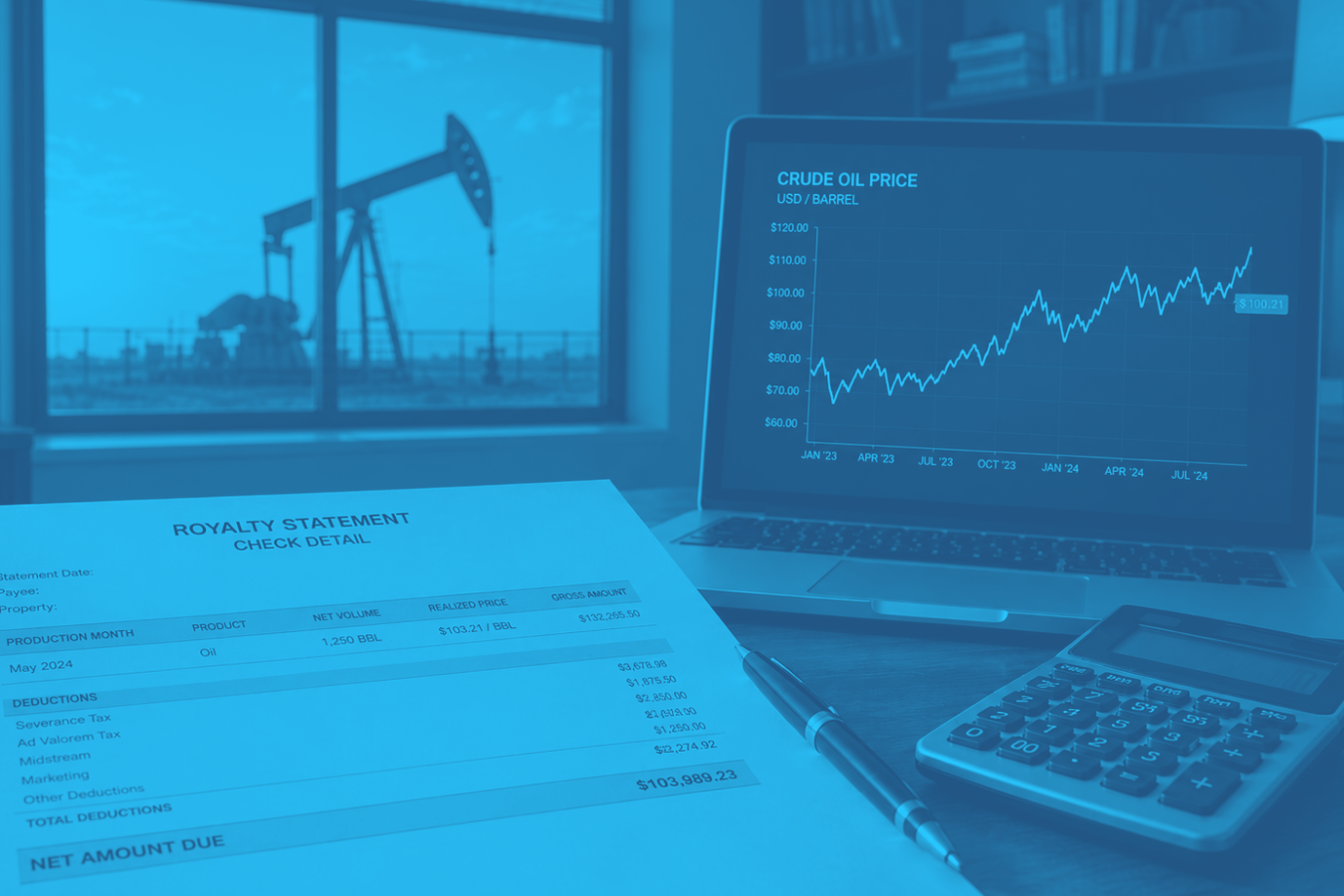
As of mid-May 2026, oil prices have been elevated for weeks, with WTI recently trading above $100 amid continued Strait of Hormuz disruption. For mineral owners, that raises an obvious question: if the market has already moved, why hasn’t my royalty check caught up?
The answer depends on which production month your check is paying, your operator’s accounting cadence, whether your production is oil- or gas-weighted, and whether deductions, suspense, title issues, or division-order problems are delaying the pass-through.
This post walks through why higher oil prices may not have fully hit your statement yet, when they could begin showing up, and what to watch for when they do.
The Royalty Payment Cycle Runs Behind the Wellhead
Production happens in real time. Payment does not. For most operators in Texas and Oklahoma, oil produced in a given month is sold, gauged, run-ticketed, and reconciled over the following 30-45 days. The operator then cuts royalty checks another 30-45 days after that. The practical result: oil pulled out of the ground in month one typically lands in your bank account in month three.
That timing matters even more when prices have been elevated for weeks. If oil first moved higher in April, your May check may still be paying March production, or only beginning to reflect early-April production depending on your operator’s payment cycle. In other words, the market may have moved — but your statement may not have reached that production month yet.
It isn’t usually operator slow-walking. It’s the result of purchaser settlement, operator accounting cycles, title review, minimum-pay thresholds, and state-specific payment rules. Valor’s mineral management team tracks these cycles operator by operator, because the lag varies — and knowing your operator’s specific cadence is the difference between expecting upside and waiting for it.
Gas Owners May Wait Longer Than Oil Owners
If your production is weighted toward gas, the timing can be even less straightforward. Oil pricing is generally tied to a posted monthly average that settles relatively quickly. Gas pricing flows through marketing contracts indexed to hubs like Waha, Henry Hub, or Houston Ship Channel, often with a one-month settlement built in before the operator even calculates your share.
Layer that on top of the standard 60-90 day royalty cycle and gas owners can wait four months or longer for a price event to show up on a check. For owners with mixed production, expect oil-weighted upside first, then a second wave on the gas side.
This is also why a short-lived price move may barely register for some gas owners. The price increase has to last long enough to survive the averaging, indexing, and settlement mechanisms built into the applicable marketing arrangement.
What Will Actually Show Up — And What Won’t
When the higher prices do flow through, the upside is rarely a clean dollar-for-dollar pass-through. A few line items on your check detail are worth watching closely:
- Realized price vs. benchmark. Your check should show the price the operator received, not the WTI or Henry Hub headline. Differentials, gravity adjustments, and gathering deductions all sit between the headline and your number.
- Post-production deductions. Transportation, processing, and compression deductions often scale with revenue. A higher price can mean higher absolute deductions, even if the percentage holds.
- Suspense. If your account is in suspense for any reason — title issue, address change, unsigned division order — the price increase accrues but doesn’t pay until suspense clears.
- Severance and ad valorem taxes. These come off the top and rise with price.
The owners who capture the most upside during volatile markets are usually the ones who already have clean records, current division orders, accurate ownership decimals, and no unresolved suspense balances. The ones who do not may be leaving real money on the table — and the operator is not always going to flag it for them.
What to Watch on Your Next Three Statements
Treat the next three royalty statements as a sequence, not three isolated checks. Pull last month’s statement, this month’s, and next month’s side by side when they arrive. You’re looking for three things.
First, review the production month on each line. That tells you which check is paying for which barrels or MCFs, and whether the statement has actually reached the period when prices were elevated.
Second, review the realized price column. If WTI or regional gas indexes moved sharply and your realized price does not move at all, that is worth investigating. There may be a valid explanation — such as basis, contract timing, or averaging — but it should be explainable.
Third, review the deduction lines. If deductions jump faster than gross revenue, or if a new deduction category appears, dig in. The issue may be legitimate, but volatile markets are exactly when small statement changes can become meaningful.
The most common owner-side miss during a price move is not necessarily missing the price event entirely. It is failing to verify that the price event was fully and accurately reflected after the lag. That verification work is exactly what our team of CPAs, CPLs, and CMMs handles for clients every month.
Why the Audit Work Matters More During Volatile Markets
In the last 36 months, Valor has recovered more than $32 million for mineral owners — money that was owed, underpaid, or never paid at all. A meaningful share of recoveries in volatile markets can trace back to familiar issues: a price event, a payment lag, a deduction that does not line up, a suspense balance that quietly accrued, or an ownership correction that was never fully resolved. Our story page walks through how that recovery work happens.
The owners most exposed to underpayment during a price spike are the ones with the least visibility into their own data. Operators are not adversaries — but they are processing tens of thousands of owner accounts on tight cycles, and the burden of catching errors falls on the owner. Volatile prices amplify both the upside and the risk of error.
If you want a second set of eyes on your statements while prices are moving — or you’re not sure whether the upside is actually flowing through — our mineral management team reviews exactly this work for owners every day. A volatile market is the worst time to be guessing.
The information provided by Valor in this blog is for general informational purposes only, not to provide specific recommendations or legal or tax-related advice. The blog/website should not be used as a substitute for competent legal advice from a licensed professional attorney in your state.
Key Takeaways
- Expect the Strait of Hormuz price spike to start hitting oil royalty checks roughly two to three months after production.
- Add another month of lag if your production is weighted toward gas, because of index-based marketing contracts.
- Verify your account is out of suspense and your division order is current before the higher-priced production settles.
- Compare realized price, deductions, and production month across your next three statements side by side.
- Flag any month where deductions rise faster than gross revenue - that's the most common underpayment within a volatile price environment.